
Kwame Daniels Brings “North Star” to New York
by Mary Hendriksen
June 1, 2026
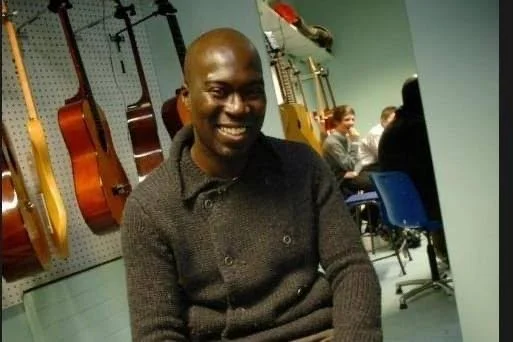
From June 3-21, New York City’s Irish Arts Center (IAC) will feature North Star, a live music and spoken word performance conceived and developed by the multidisciplinary creative Kwame Daniels and inspired by the speeches of abolitionist Frederick Douglass during his historic visit to Belfast in 1845.
In that year, only seven years after escaping slavery and immediately after publishing his first book, Narrative of the Life of Frederick Douglass, an American Slave, Douglass journeyed to Ireland, visiting Dublin, Waterford, Limerick, and then Belfast. He spent several weeks in Belfast, delivering speeches and engaging local abolitionists. The stay was both influential to Douglass, who felt so welcomed that he said, “I know I will always have a home in Belfast,” and pivotal for the town, where the Belfast Ladies’ Anti-Slavery Association formed following his visit. In 2023, Belfast unveiled a statue of Douglass—the only one in Europe and the spark for the creation of North Star.
Described as a collaborative, immersive standing-room show, North Star fuses artistic responses to Douglass’s experience from an eclectic range of contemporary artists—including hip-hop, jazz, gospel, electronic and classical musicians, poets, and young people. Central to it is an inquiry about the nature of welcome: What makes a place hospitable to new people, to new ideas? What made Belfast feel like “home” to Douglass in 1845, and for whom do Belfast, and New York, feel like a home today? For these questions, in addition to featuring responses of established artists, North Star engaged with young people in both cities. New York City students will appear in the upcoming June performances reading their work.
The U.S. premiere of North Star is produced and presented by the Irish Arts Center and Solab, in association with the Lyric Theatre, Belfast. Solab, an initiative founded by Kwame Daniels, builds a digital platform for artists across Africa, the African Diaspora, and their wider creative networks. North Star emerged originally from Belfast 2024, the city’s cultural arts program that encompassed more than 200 arts projects, and is a Belfast City Council and Belfast Stories co-commission. Its production at the Irish Arts Center is supported by Culture Ireland, Northern Ireland Bureau, Tourism Ireland, and the British Council of Northern Ireland.
Watch the trailer of North Star
To find out more about North Star and its creation, read the interview below with creator Kwame Daniels by Christine Kinealy, professor of history at Quinnipiac University, director of Ireland's Great Hunger Institute, and AAIDN board member, who serves as the show’s history consultant. Their conversation has been condensed and edited, below.
North Star creator Kwame Daniels speaks with historian Christine Kinealy about its genesis, creation, and reception in Belfast
In mid-May, Daniels spoke with historian Christine Kinealy, consultant to the show, to explore the genesis and creation of North Star, as well as how audiences in Belfast responded to it.
CK: Kwame, when did you become aware of Frederick Douglass?
I grew up in London, in a Ghanaian household, with a focus on Ghanaian culture rather than Black history as a whole. The first time I heard of Douglass was in sixth form, when a friend of mine who was very interested in African American history told me about him. Douglass came more into my sphere and consciousness when I studied history at University–but that was only a brief module. The real spark of fascination was in 2023, when a statue of Douglass was unveiled in Belfast, my home since 2013. I knew then that I had to find out more about Douglass’s own personal journey, his journey to Ireland, and how he was received here.
CK: And what was the genesis of North Star?
Actually, North Star is a creation 30 years in the making.
In 1993, Stephen Lawrence, a Black British 18-year-old student, was murdered in an unprovoked and racially motivated attack at a bus stop in London. I knew at the time that I, or any one of my friends, could have been the one attacked. Lawrence’s murder and its aftermath was an important event in my quest to learn about racism and its motivations.
Then, in 2020, George Floyd’s murder in America had its own effects in Ireland. As in the US, while some people were questioning racism, others were questioning the need for a Black Lives Matter movement.
To counter this, I decided to set up a project, based within the island of Ireland, that would be designed to enable people to become closer to African cultures and people. That became Solab, a digital platform for artists across Africa, the African Diaspora, and their wider creative networks. We create online spaces where practitioners can imagine, discuss, develop, and test ideas—collaboratively and across borders.
The last step in the genesis of North Star was the announcement in Belfast, in 2023, that the city would host an innovative cultural arts programme, Belfast 2024. That was my ‘lightbulb moment.’ I could put it all together: the murders of Stephen Lawrence and George Floyd, the Black Lives Matter movement, motivations of racism, and how a place welcomes—or does not welcome—people and new ideas. The inspirational story of Douglass’s time in Belfast became the vehicle in which I could explore and link all these themes.
When actor Colin Salmon came on board, I really knew what the show could be. His wife is from Belfast, so he had experiences in and memories of the city.
CK: I saw the show in Belfast and have never experienced anything like it. The performance was so powerful, and the audience was visibly affected. It made a lasting impression—and I knew the story. What are your takeaways from the Belfast run?
The show in Belfast premiered only 16 weeks after the anti-immigration riots in Ireland–including Belfast, across the North and the UK. Those events were still top-of-mind in people’s memories and held much emotional energy.
I was not prepared for the tears–some from people who were proud that the city could hold such a conversation, some from people who professed that they knew nothing about Douglass’s visit to this city, and some who said that they had rarely been close to people from different cultures. Attendees from the Black community came to realise public displays of ‘Black joy’ had never been seen in such a high-profile setting.
Neither did I truly realize how powerful North Star would be in empowering youth, many who felt unseen, to express themselves and then to share those expressions in a public space. Sadly, I discovered that the older the students are, the darker their reflections. The world looks much different to a 15-year-old than it does to a boy or girl of 10 or 11. We need to ask what we can do to amplify the voices of young people, particularly those who are unseen. I believe that North Star has the potential to be a template to engage and platform marginalised communities.
From a musical standpoint, even as a gig on its own, the show and its array of talented artists is amazing.
Finally, from an educational standpoint, it’s important to question schools’ curriculum and to ask: How many more moments–like Douglass’s stay in Belfast–can be powerful tools? I hope the show can be the start of how we can spotlight more moments that hold the potential for explorations of any number of subjects related to race and belonging..